Rock Lake 18: 2-3 July 2016

Home |
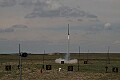
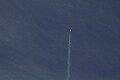
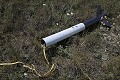
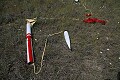
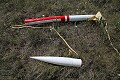
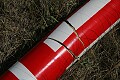
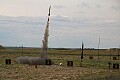
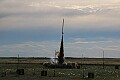
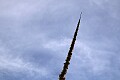
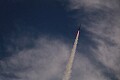
Sunday morning safety briefing... testing the fire suppression system... weather was beautiful... lawn chairs and rockets... even Murray from Edmonton showed up, <br />with two large airframes... a miniature city... during the morning launches, Al gave a warm hearted <br />dedication to our late friend, Ron Veale... a fire spitting Sparky motor... under a bright sun... ignition... and liftoff of a "K" powered rocket... under perfect conditions... very little cross wind... nice straight flight... drogue at apogee... textbook dual-deployment recovery... happy flyers... John Glasswick's "M" powered <br />rocket was next... it was out on the far pad... away it went... this flight was an altitude <br />record attempt... which was helped by good <br />weather conditions... the rocket flew on a CTI 7521Ns-M840... which puts out around 400 lbs of initial thrust, then an <br />average thrust of around 200 lbs for 10 more seconds... which propelled the rocket to over 20,000 ft... under what can only be described <br />as perfect skies... leaving a picturesque contrail... It was an enjoyable flight to watch. It turned out that John's rocket <br />reached an altitude of 23,150ft. This was a new Canadian record <br />for "M" class motors. Congratulations John!... last minute prep for our rocket... final inspections... Ian with GL Vertical Assault 54mm... Mary-Ann out at the launch rails. The rocket carries two altimeters, <br />a Telemetrum GPS that broadcasts realtime position and <br />telemetry on the 70cm band, and a Raven3 for dual-deployment... installing the igniter... both altimeters are started... the Telemetrum was re-initialized remotely and we confirmed it <br />was transmitting correctly using the 3-element Yagi antennae... 3...2...1... and away it goes, powered by a <br />K300-2545Ns CTI motor... the rocket lifts off on <br />125 lbs of initial thrust... followed by 70 lbs of <br />sustained average thrust... which continued for <br />eight more seconds... conditions were ideal... and the rocket flew absolutely straight... still burning... until it went out of sight... Mary-ann maintained a continuous lock on the radio <br />downlink. This told us where the rocket was <br />even though we couldn't see it... unfortunately we lost sight of the rocket and did not <br />see it land, so it was time to go looking for it... we found it about a mile away <br />in some tall grass... we would likely have never <br />found it without the GPS... it was clear the rocket had <br />sustained some damage... and a closer inspection revealed <br />it was quite severe... the airframe was badly cracked, indicating a hard landing. <br />What was curious was that the nosecone did separate.... but the main chute did not deploy... the upper payload section sustained a hard impact.<br />Note the visible shear pin... this shows a piece of nomex blanket that was pinched in the airframe where <br />it cracked. This leads to further speculation of what prevented the main <br />from deploying...  could the inside of the upper section been sticky, perhaps from <br />residue from the previous launch, or perhaps, was the ejection charge sufficient <br />to burst the airframe forcing part of the blanket into the crack?... the av-bay also hit hard. After examination, it didn't seem as though <br />the deployment charge could have caused the bay to shatter, <br />so the only other conclusion is that it broke on landing... once back on site, the altimeter <br />bays were disassembled... the data records were recovered <br />off both of them... the Telemetrum sled took a hard hit and cracked at the rear <br />screw mounts, the board itself does not seem damaged... the reverse side... the back of the Raven3 sled, fiberglass holding one sleeve was <br />cracked, and remarkably, two of the tie-wraps were also broken. <br />This is likely the result of the hard impact on landing... on the Raven3 the epoxy around the black capacitor was cracked, <br />and curiously, the metal housing around the USB port was warped. <br />This needed to be bent slightly to get the USB plug to fit <br />to extract the flight data... the launches continued <br />into the afternoon... another Sparky motor... Richard's "L" powered rocket... a Red Lightning motor... Murray's enormous "L" powered <br />rocket was next... this was an electronics certification <br />flight for Murray... it lifted off very fast... and struggled at first to stay straight... but then got back on track... and soared straight up... with that black exhaust plume,<br />it was easy to track... but it soared so high it wasn't possible to see if the <br />drogue chute deployed at apogee, one of the <br />requirements of the elec. certification. <br />The rocket was spotted floating away to the north-east... a few late afternoon launches... capped off the day... and a great weekend... Murray did eventually find his rocket though... about two miles away in a grain field.<br />But not before a farmer managed to run over it with his weed sprayer first,<br />damaging his electronics bay, breaking the carbon fibre airframe and <br />ripping up the parachute... tough luck Murray... Sunday morning, after the clean up. <br />So long until next time... We drove up to Dino Park, where it rained <br />hard that night. Nice to have a camper... our tour the next day was cancelled <br />since the road washed out... so we hiked around the nearby hills <br />and viewpoints ourselves... saw the ubiquitous Centrosaurous... where it has rested for 60 million years... and found some other sites, whose specimens <br />are now in a museum somewhere... bonebed marker... Ian... clear skies to the East... a different story to the West... our soggy but peaceful campsite.